
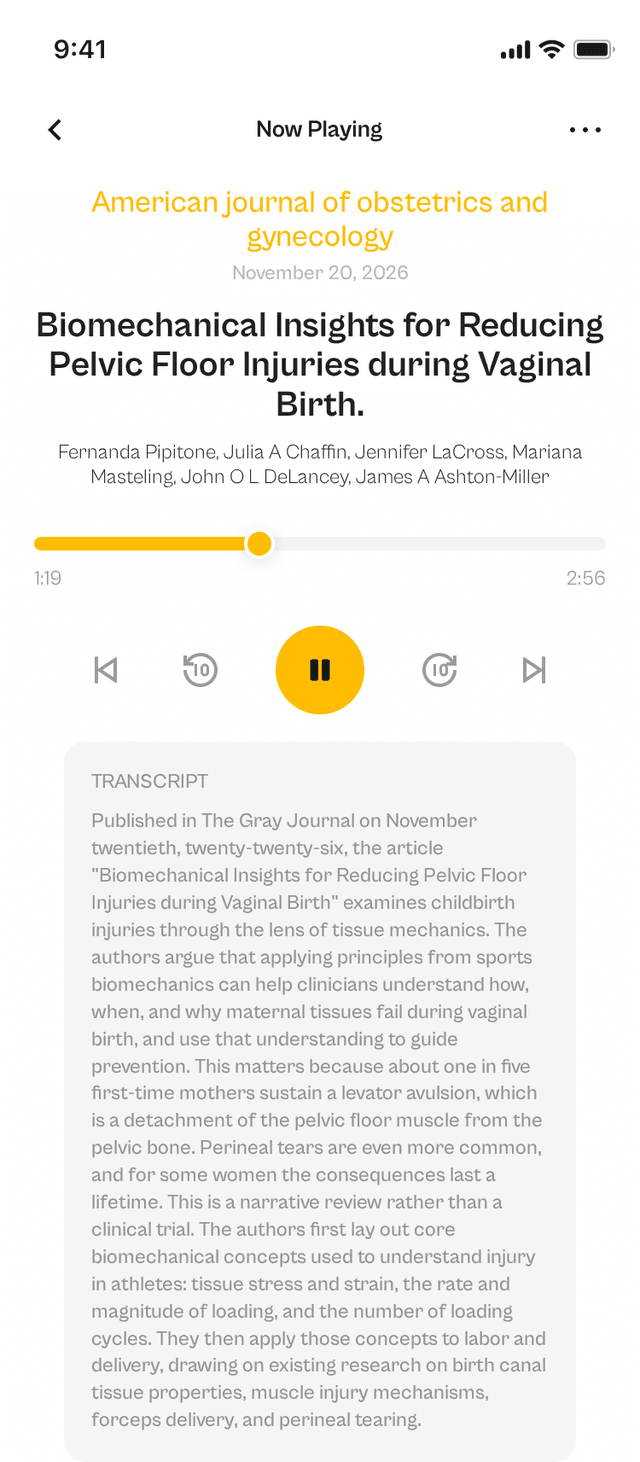
Biomechanical Insights for Reducing Pelvic Floor Injuries during Vaginal Birth.
Listen to this summary
This review applies sports biomechanics principles, such as tissue stress and strain, loading rate, and loading cycles, to explain how and why maternal pelvic floor and perineal tissues fail during vaginal birth. The authors examine how tissue viscoelasticity (hysteresis, creep, stress relaxation) aids birth canal dilation, how factors like forceps delivery, rapid loading, and stress concentration raise injury risk, and how eccentric loading of a contracted levator ani increases injury likelihood. They conclude that individual tissue compliance differences and capacity-demand mismatches should guide at-risk identification, prenatal pelvic floor relaxation training, and clinical decisions to reduce birth-related injuries.
This is one of 33,000+ journals available on OSLR. Try it free for 14 days.
Free 14-day trial. 33,000+ journals. Cancel anytime.
More from American journal of obstetrics and gynecology
View all →Nov 14, 2026 · American journal of obstetrics and gynecology
Ultrasound-guided suction with balloon tamponade for cesarean scar ectopic pregnancy: a combined treatment strategy.
Nov 13, 2026 · American journal of obstetrics and gynecology
Hofbauer Cells and Placental Villous Inflammation in Spontaneous Preterm Birth: Spatial and Functional Analyses.
Nov 5, 2026 · American journal of obstetrics and gynecology
Baclofen Vaginal Suppositories in Chronic Pelvic Pain: a Randomized, Double-Blind, Placebo Controlled Trial.
Nov 5, 2026 · American journal of obstetrics and gynecology
Urgency urinary incontinence, one condition, or many? Cluster analysis of physiological variables in the Symptoms of Lower Urinary Tract Dysfunction Research Network (LURN) II cohort.
Oct 28, 2026 · American journal of obstetrics and gynecology
Hysterectomy-corrected, age-specific incidence and survival of uterine sarcomas by histotype, race and ethnicity in the United States, 2000-2019.
Oct 26, 2026 · American journal of obstetrics and gynecology
Loop electrosurgical excision procedure with or without intraoperative iodine: A randomized controlled trial.
More in Obstetrics & Gynecology
View all →Nov 20, 2026 · Reproductive biology and endocrinology : RB&E
Sirtuin 1-dependent oleanolic acid protection attenuates oxidative stress-induced granulosa cell dysfunction and ovarian damage.
Nov 20, 2026 · BMC women's health
HDAC2/Parkin axis regulates mitochondrial dysfunction and mitophagy in polyendocrine metabolic ovarian syndrome.
Nov 20, 2026 · BMC women's health
Long-term risk of second primary malignancies and symptomatic heart failure after pegylated liposomal doxorubicin versus conventional anthracycline-based chemotherapy in early-stage breast cancer survivors: a single-center experience.
Nov 20, 2026 · BMC women's health
Association between internet use and unmet need for family planning among currently pregnant women in Bangladesh: evidence from BDHS 2022.
Nov 20, 2026 · Journal of pain and symptom management
Perceived Clinical Utility of a Routine Family Experience Feedback Loop in Pediatric Palliative Care.
Nov 20, 2026 · Journal of pain and symptom management
ACCOMPANI: A Psychosocial Nurse Intervention for African American Families in Pediatric Oncology.
"Oslr has become part of my weekly routine on my day off. The clinical relevance of the summaries is outstanding — I'd rate it 9/10. Being able to consume research hands-free is a huge advantage for busy physicians."

Dr. Jennifer Thompson
Portland, OR
Stay current without falling behind
33,000+ journals. 3-minute audio summaries. Free for 14 days.