
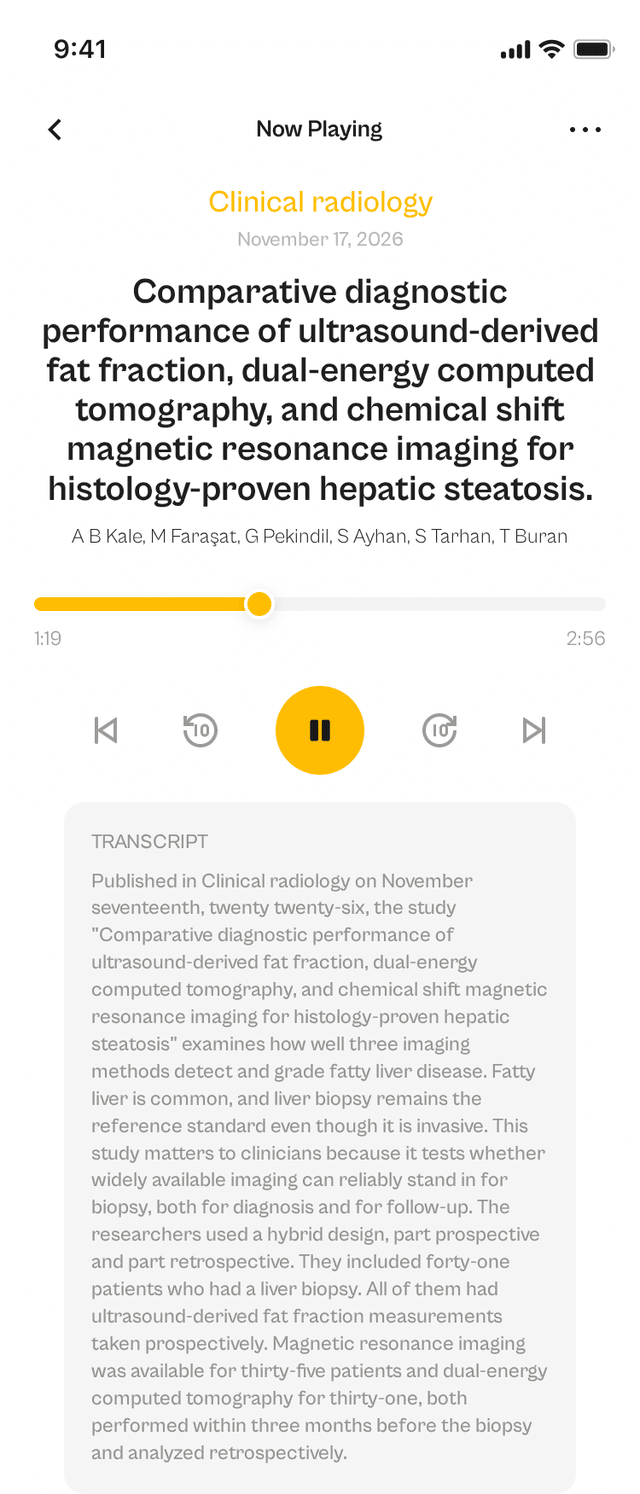
Comparative diagnostic performance of ultrasound-derived fat fraction, dual-energy computed tomography, and chemical shift magnetic resonance imaging for histology-proven hepatic steatosis.
Listen to this summary
This study compared ultrasound-derived fat fraction (UDFF), chemical shift MRI, and dual-energy CT for detecting and grading hepatic steatosis against liver biopsy histology in 41 patients (with MRI and DECT available for subsets, and a 25-patient head-to-head subgroup). The authors asked whether these noninvasive modalities accurately assess steatosis and whether any one performs best across severity levels. All three correlated strongly with histologic grade, with MRI best for mild steatosis, DECT best for severe steatosis, and UDFF performing comparably well, supporting UDFF as a reliable, widely accessible alternative for clinical monitoring.
This is one of 33,000+ journals available on OSLR. Try it free for 14 days.
Free 14-day trial. 33,000+ journals. Cancel anytime.
More from Clinical radiology
View all →Nov 15, 2026 · Clinical radiology
Association of baseline chest computed tomography (CT) findings with inpatient sputum smear positivity and grade in active pulmonary tuberculosis: a retrospective study.
Nov 13, 2026 · Clinical radiology
Diagnostic performance of the Kaiser score in differentiating histopathologic subgroups of intraductal papillomas on breast magnetic resonance imaging.
Nov 9, 2026 · Clinical radiology
Triple-rule-out computed tomography (CT) angiography revisited: selective contemporary use enabled by sequential acquisition and modern cardiovascular computed tomography (CT).
Nov 7, 2026 · Clinical radiology
Sex-based variability of water-equivalent diameter (Dw) and dosimetric parameters in adult head computed tomography (CT): implications for protocol optimisation.
Nov 6, 2026 · Clinical radiology
RapidAI compared to RapidAI-assisted neuroradiologist interpretation in evaluating acute ischaemic stroke: A local experience.
Nov 6, 2026 · Clinical radiology
Thoracic ultrasound for assessing chest wall invasion in lung cancer with suspected chest wall involvement: a systematic review and meta-analysis.
More in Radiology
View all →Nov 20, 2026 · Abdominal radiology (New York)
Five-compartment restriction spectrum imaging for noninvasive assessment of liver fibrosis in chronic liver disease.
Nov 20, 2026 · Abdominal radiology (New York)
Diagnostic performance of liver virtual non-contrast and virtual unenhanced reconstructions derived from photon-counting detector CT of the upper abdomen.
Nov 20, 2026 · Abdominal radiology (New York)
Robust visualization of the right adrenal vein using photon-counting CT across all BMI groups.
Nov 19, 2026 · Journal of ultrasound in medicine : official journal of the American Institute of Ultrasound in Medicine
Hepatic Ectopic Pregnancy: A 70-Year Systematic Review Focusing on Ultrasound Diagnosis.
Nov 19, 2026 · Journal of ultrasound in medicine : official journal of the American Institute of Ultrasound in Medicine
Predictive Model for Early Identification of Poor Prognosis in Kidney Transplant Recipients Based on Ultrasound Hemodynamic Parameters Combined with Clinical and Laboratory Indicators: A Retrospective Cohort Study.
Nov 19, 2026 · Lancet (London, England)
Reproductive health in women in Britain from 2010 to 2024: findings from repeated, cross-sectional National Surveys of Sexual Attitudes and Lifestyles (Natsal).
"Oslr has become part of my weekly routine on my day off. The clinical relevance of the summaries is outstanding — I'd rate it 9/10. Being able to consume research hands-free is a huge advantage for busy physicians."

Dr. Jennifer Thompson
Portland, OR
Stay current without falling behind
33,000+ journals. 3-minute audio summaries. Free for 14 days.