
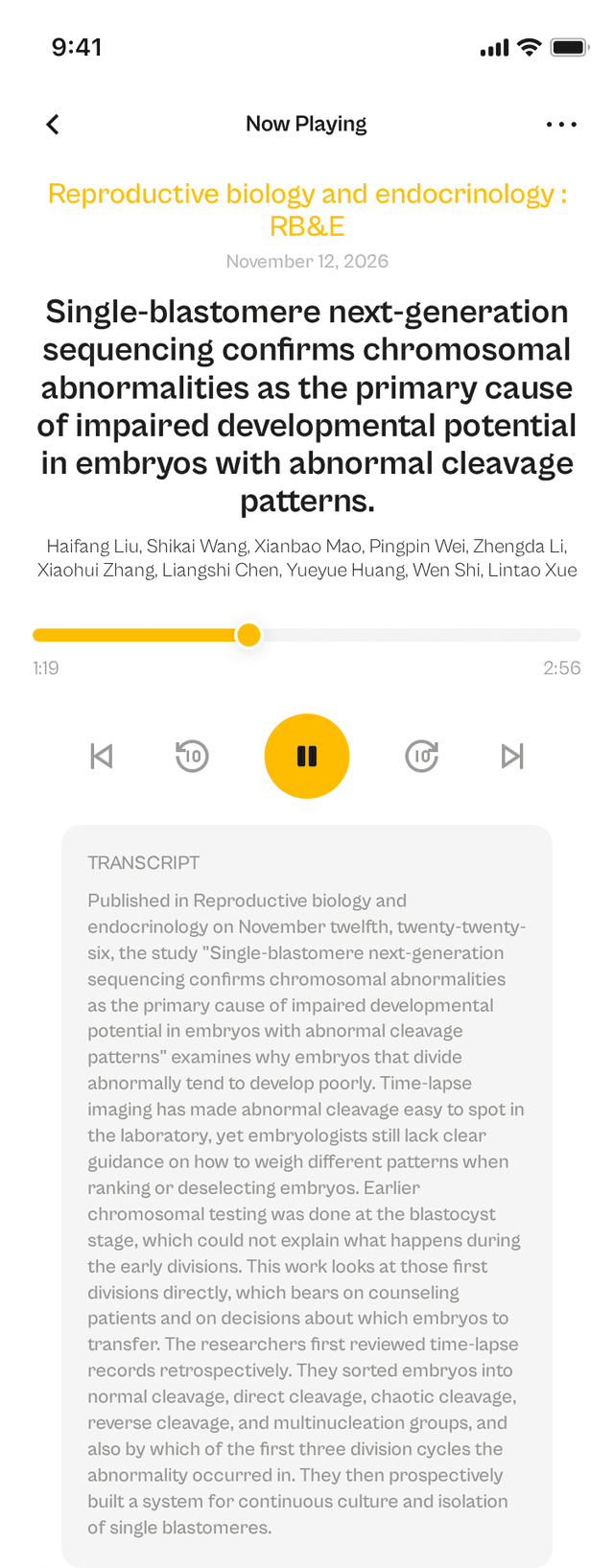
Single-blastomere next-generation sequencing confirms chromosomal abnormalities as the primary cause of impaired developmental potential in embryos with abnormal cleavage patterns.
Listen to this summary
This study asks how different abnormal cleavage patterns (direct, chaotic, reverse cleavage, and multinucleation) and their timing affect embryonic developmental potential, and whether these abnormalities are linked to chromosomal errors. Using time-lapse analysis of embryos and a novel single-blastomere continuous culture and sequencing system, the authors found that abnormal cleavage significantly reduced blastocyst formation, with direct and chaotic cleavage being most harmful and early-stage abnormalities (DC1, RC1) particularly detrimental. Direct and chaotic cleavage also showed the highest chromosomal abnormality rates (100% and 86.96%), leading the authors to conclude that chromosomal abnormalities are a primary cause of impaired developmental potential in these embryos.
This is one of 33,000+ journals available on OSLR. Try it free for 14 days.
Free 14-day trial. 33,000+ journals. Cancel anytime.
More from Reproductive biology and endocrinology : RB&E
View all →Nov 20, 2026 · Reproductive biology and endocrinology : RB&E
Sirtuin 1-dependent oleanolic acid protection attenuates oxidative stress-induced granulosa cell dysfunction and ovarian damage.
Nov 13, 2026 · Reproductive biology and endocrinology : RB&E
Pre-IVF lifestyle intervention and reproductive outcomes in women with overweight or obesity undergoing IVF: a randomized clinical trial.
Nov 8, 2026 · Reproductive biology and endocrinology : RB&E
Reproductive factors and mortality risk: insights from the Tehran Lipid and Glucose Study (TLGS).
Nov 5, 2026 · Reproductive biology and endocrinology : RB&E
Female infertility in nonclassic congenital adrenal hyperplasia: beyond hyperandrogenism.
Nov 3, 2026 · Reproductive biology and endocrinology : RB&E
Effects of progestin-primed ovarian stimulation protocol plus clomiphene citrate in patients with low basal LH levels: a randomized controlled trial.
Nov 2, 2026 · Reproductive biology and endocrinology : RB&E
Effect of ejaculatory abstinence duration on laboratory semen parameters: a systematic review and meta-analysis of human studies.
More in Obstetrics & Gynecology
View all →Nov 20, 2026 · BMC women's health
HDAC2/Parkin axis regulates mitochondrial dysfunction and mitophagy in polyendocrine metabolic ovarian syndrome.
Nov 20, 2026 · BMC women's health
Long-term risk of second primary malignancies and symptomatic heart failure after pegylated liposomal doxorubicin versus conventional anthracycline-based chemotherapy in early-stage breast cancer survivors: a single-center experience.
Nov 20, 2026 · BMC women's health
Association between internet use and unmet need for family planning among currently pregnant women in Bangladesh: evidence from BDHS 2022.
Nov 20, 2026 · Journal of pain and symptom management
Perceived Clinical Utility of a Routine Family Experience Feedback Loop in Pediatric Palliative Care.
Nov 20, 2026 · Journal of pain and symptom management
Predictors of Clinician Success, Quality, and Resilience in Outpatient Pediatric Palliative Care.
Nov 20, 2026 · Journal of pain and symptom management
ACCOMPANI: A Psychosocial Nurse Intervention for African American Families in Pediatric Oncology.
"Oslr has become part of my weekly routine on my day off. The clinical relevance of the summaries is outstanding — I'd rate it 9/10. Being able to consume research hands-free is a huge advantage for busy physicians."

Dr. Jennifer Thompson
Portland, OR
Stay current without falling behind
33,000+ journals. 3-minute audio summaries. Free for 14 days.