
Blockade of the Succinate-SUCNR1 Metabolic Axis Helps Restore Mitochondrial Homeostasis and Prevents Structural Failure in Overuse-Induced Rotator Cuff Tendinopathy in a Mouse Model.
Listen to this summary
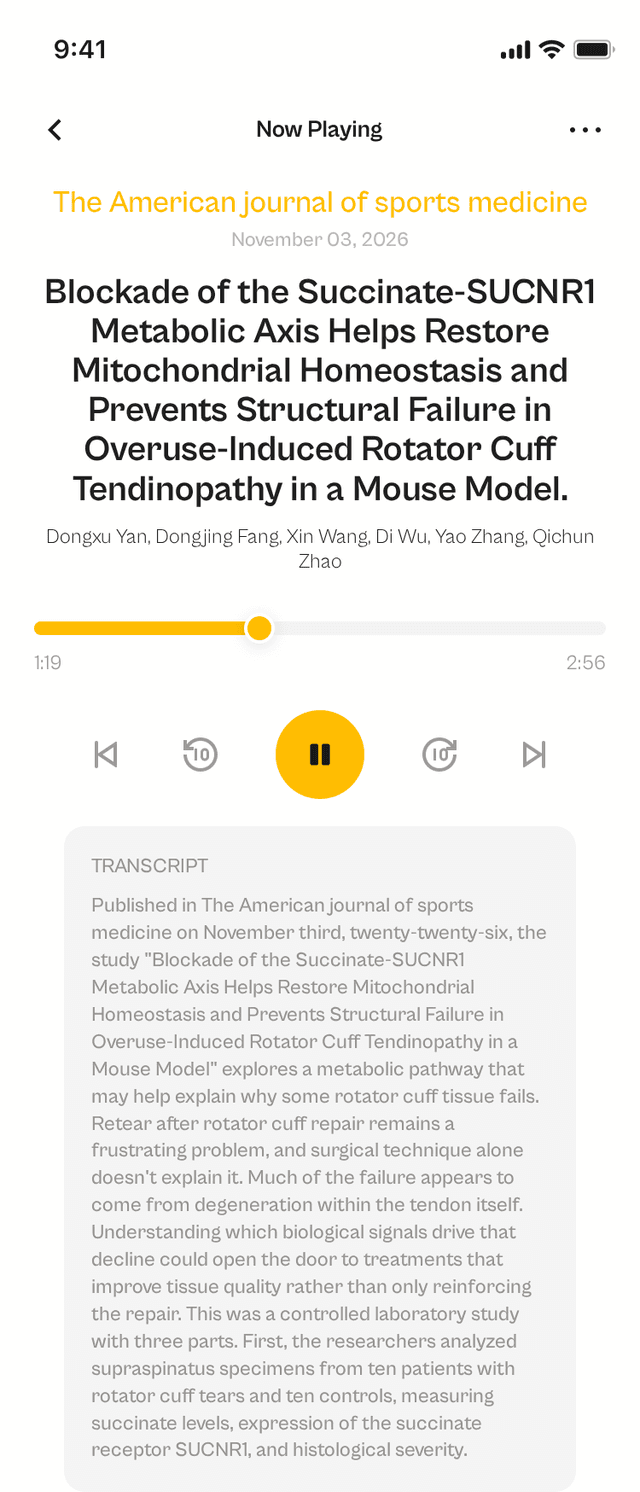
The authors asked whether the succinate-SUCNR1 metabolic axis is overactive in torn human rotator cuff tendons and whether blocking it protects against overuse-induced tendon degeneration and mechanical failure. In human supraspinatus samples, succinate levels and SUCNR1 expression rose with degeneration severity, and in a mouse treadmill overuse model, Sucnr1-deficient mice showed less inflammation, less abnormal neovascularization, preserved collagen structure, and retained stiffness and failure load compared with wild-type mice. In senescent tendon stem cells, the SUCNR1 antagonist Compound 20 restored mitochondrial respiration and reduced senescence, suggesting that targeting this axis could help preserve tendon quality and potentially reduce retear rates after repair.
This is one of 33,000+ journals available on OSLR. Try it free for 14 days.
Free 14-day trial. 33,000+ journals. Cancel anytime.
More from The American journal of sports medicine
View all →Nov 17, 2026 · The American journal of sports medicine
Is There an Association Between Abnormal Patellofemoral Morphology and Patellofemoral Osteochondritis Dissecans in Pediatric Patients?
Nov 10, 2026 · The American journal of sports medicine
Effect of Mechanical Alignment on Clinically Significant Outcomes, Reoperation, and Failure After Osteochondral Allograft Transplantation of the Knee.
Nov 6, 2026 · The American journal of sports medicine
A Single Intra-articular Injection of Autologous Stromal Vascular Fraction for Moderate-to-Severe Knee Osteoarthritis: Results of a Multicenter Randomized Placebo-Controlled Trial With 12-Month Follow-up.
Nov 6, 2026 · The American journal of sports medicine
Microfracture at the Acetabular Rim as Biological Augmentation of Labral Reconstruction Improves Autograft Vascularization and Integration: A Porcine Model.
Nov 6, 2026 · The American journal of sports medicine
Proximal Versus Joint Line Medial Collateral Ligament Trephination (Pie-Crusting): Effects on Meniscal Extrusion and Tibiofemoral Contact Mechanics in a Cadaveric Model.
Nov 3, 2026 · The American journal of sports medicine
Altered Cognitive Control and Cortical Oscillatory Dynamics in Athletes With ACL Reconstruction During Decision-Making Under Uncertainty.
More in Physical Therapy Assistant
View all →Nov 18, 2026 · Orthopaedic journal of sports medicine
Sex Does Not Influence Graft Failure or Functional Recovery After Anterior Cruciate Ligament Reconstruction: A Systematic Review and Meta-Analysis.
Nov 18, 2026 · Orthopaedic journal of sports medicine
Incidence of Flatfoot Deformity After Anterior Cruciate Ligament Reconstruction Using Peroneus Longus Autograft: A Mid-Term Observational Study.
Nov 18, 2026 · Orthopaedic journal of sports medicine
Anterior Capsulolabral Repair During Arthroscopic Latarjet Reduces the Risk of Osteoarthritis Development: A Matched-Pair Study.
Nov 18, 2026 · Orthopaedic journal of sports medicine
Some Skeletally Immature Patients Have Lower Limb Length Discrepancies and/or Malalignment Prior to Anterior Cruciate Ligament Reconstruction: Baseline Radiographic Data from the PLUTO Cohort.
Nov 18, 2026 · Orthopaedic journal of sports medicine
Translation, Validity, and Reliability of the Indonesian Version of the Injury-Psychological Readiness to Return to Sport (I-PRRS-INA) Scale.
Nov 18, 2026 · Orthopaedic journal of sports medicine
Tendon Graft Augmentation Was Not Associated With Improved Outcomes in Acute Bidirectionally Unstable High-Grade AC Joint Injuries: A Retrospective Cohort Study.
"Oslr has become part of my weekly routine on my day off. The clinical relevance of the summaries is outstanding — I'd rate it 9/10. Being able to consume research hands-free is a huge advantage for busy physicians."

Dr. Jennifer Thompson
Portland, OR
Stay current without falling behind
33,000+ journals. 3-minute audio summaries. Free for 14 days.