
Cinnamon supplementation in broiler and laying hen diets: benefits, mechanisms, supplementation doses, and limitations - a review.
Listen to this summary
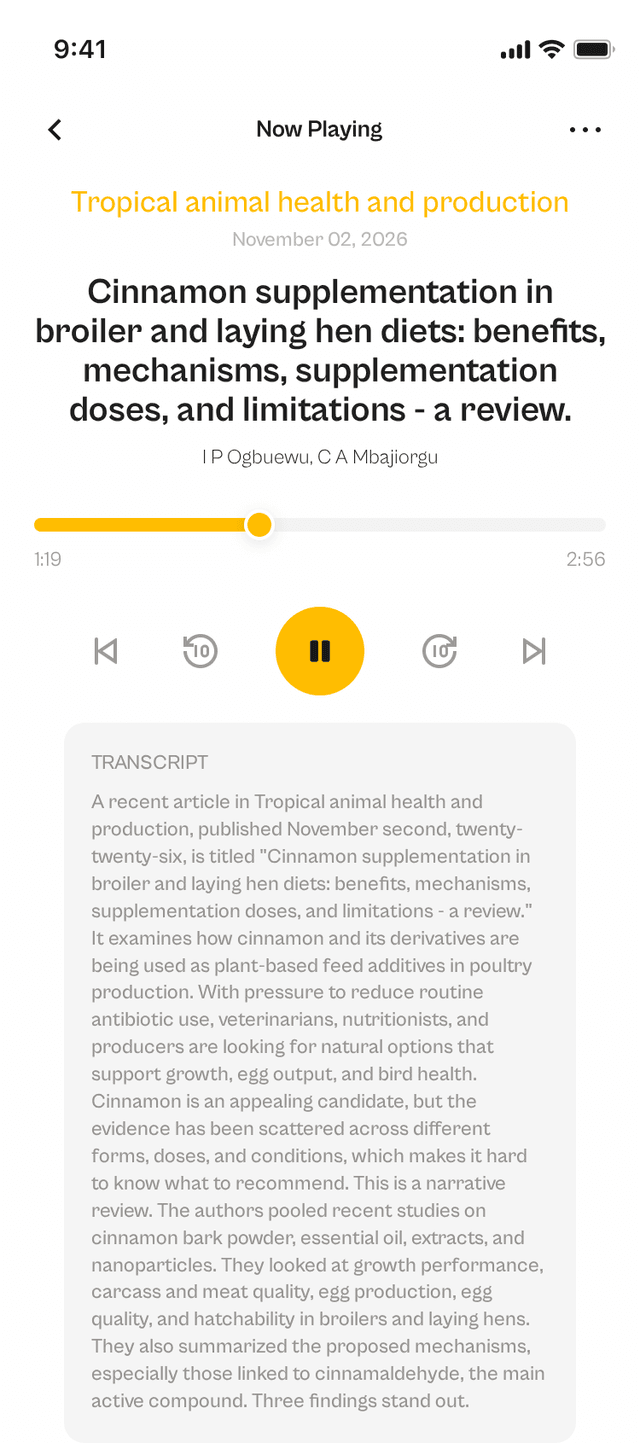
This review synthesizes studies on cinnamon and its derivatives (bark powder, essential oil, extract, nanoparticles) as phytogenic feed additives for broilers and laying hens, examining effects on growth, meat and egg quality, and hatchability, along with the mechanisms involved. The authors aim to identify effective supplementation doses and limitations, finding that optimal levels vary by form and conditions (e.g., 0.2–0.5% bark powder for broilers, 0.75–1.0% for laying hens), while excessive doses can reduce feed intake and disrupt gut microbiota. They conclude that results are inconsistent across studies, so standardized, region-specific research is needed before widespread commercial adoption.
This is one of 33,000+ journals available on OSLR. Try it free for 14 days.
Free 14-day trial. 33,000+ journals. Cancel anytime.
More from Tropical animal health and production
View all →Nov 2, 2026 · Tropical animal health and production
The supplementation of a mixture of plant hydroalcoholic extract in drinking water and its effect on performance, carcass, jejunal morphology, and ileum microbiota in broiler chickens.
Nov 2, 2026 · Tropical animal health and production
The evaluation of dietary protein levels and the comparative application of the NASEM model for ration formulation in finishing Nellore cattle.
Oct 30, 2026 · Tropical animal health and production
Phytogenic feed additives for climate-resilient camel production in arid and semi-arid regions: current evidence and research priorities.
Oct 26, 2026 · Tropical animal health and production
Development of a recombinant MOMP-based indirect ELISA for the serodiagnosis of caprine chlamydiasis.
Oct 26, 2026 · Tropical animal health and production
Smart livestock management using sensing technologies: applications, digital integration, and future perspectives.
Oct 23, 2026 · Tropical animal health and production
Mucosal disease associated with BVDV-1b and BVDV-1e in cattle in Southern Brazil.
"Oslr has become part of my weekly routine on my day off. The clinical relevance of the summaries is outstanding — I'd rate it 9/10. Being able to consume research hands-free is a huge advantage for busy physicians."

Dr. Jennifer Thompson
Portland, OR
Stay current without falling behind
33,000+ journals. 3-minute audio summaries. Free for 14 days.