
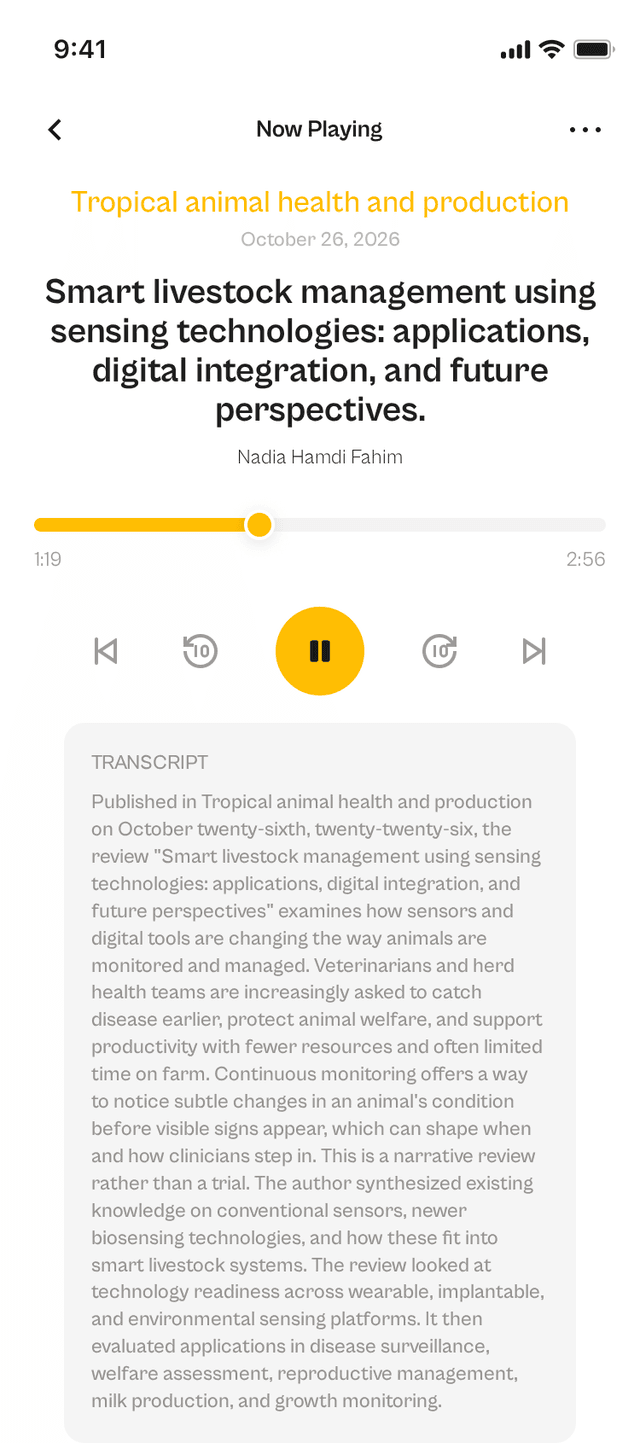
Smart livestock management using sensing technologies: applications, digital integration, and future perspectives.
Listen to this summary
This review examines how sensing and biosensing technologies, combined with IoT, AI/machine learning, cloud/edge computing, and decision-support systems, can enable smart livestock management across health, welfare, reproduction, milk production, and growth monitoring. The author asks whether integrating these technologies offers a more comprehensive view of animal physiological, behavioral, and environmental status than individual tools, and finds that it supports earlier interventions and better production efficiency. The paper also identifies barriers to large-scale adoption, such as reliability, interoperability, data management, cost, and regulatory and ethical concerns.
This is one of 33,000+ journals available on OSLR. Try it free for 14 days.
Free 14-day trial. 33,000+ journals. Cancel anytime.
More from Tropical animal health and production
View all →Nov 2, 2026 · Tropical animal health and production
The evaluation of dietary protein levels and the comparative application of the NASEM model for ration formulation in finishing Nellore cattle.
Nov 2, 2026 · Tropical animal health and production
The supplementation of a mixture of plant hydroalcoholic extract in drinking water and its effect on performance, carcass, jejunal morphology, and ileum microbiota in broiler chickens.
Nov 2, 2026 · Tropical animal health and production
Cinnamon supplementation in broiler and laying hen diets: benefits, mechanisms, supplementation doses, and limitations - a review.
Oct 30, 2026 · Tropical animal health and production
Phytogenic feed additives for climate-resilient camel production in arid and semi-arid regions: current evidence and research priorities.
Oct 26, 2026 · Tropical animal health and production
Development of a recombinant MOMP-based indirect ELISA for the serodiagnosis of caprine chlamydiasis.
Oct 23, 2026 · Tropical animal health and production
Mucosal disease associated with BVDV-1b and BVDV-1e in cattle in Southern Brazil.
"Oslr has become part of my weekly routine on my day off. The clinical relevance of the summaries is outstanding — I'd rate it 9/10. Being able to consume research hands-free is a huge advantage for busy physicians."

Dr. Jennifer Thompson
Portland, OR
Stay current without falling behind
33,000+ journals. 3-minute audio summaries. Free for 14 days.