
Chloride dysregulation: the next target for chronic pain therapeutics.
Listen to this summary
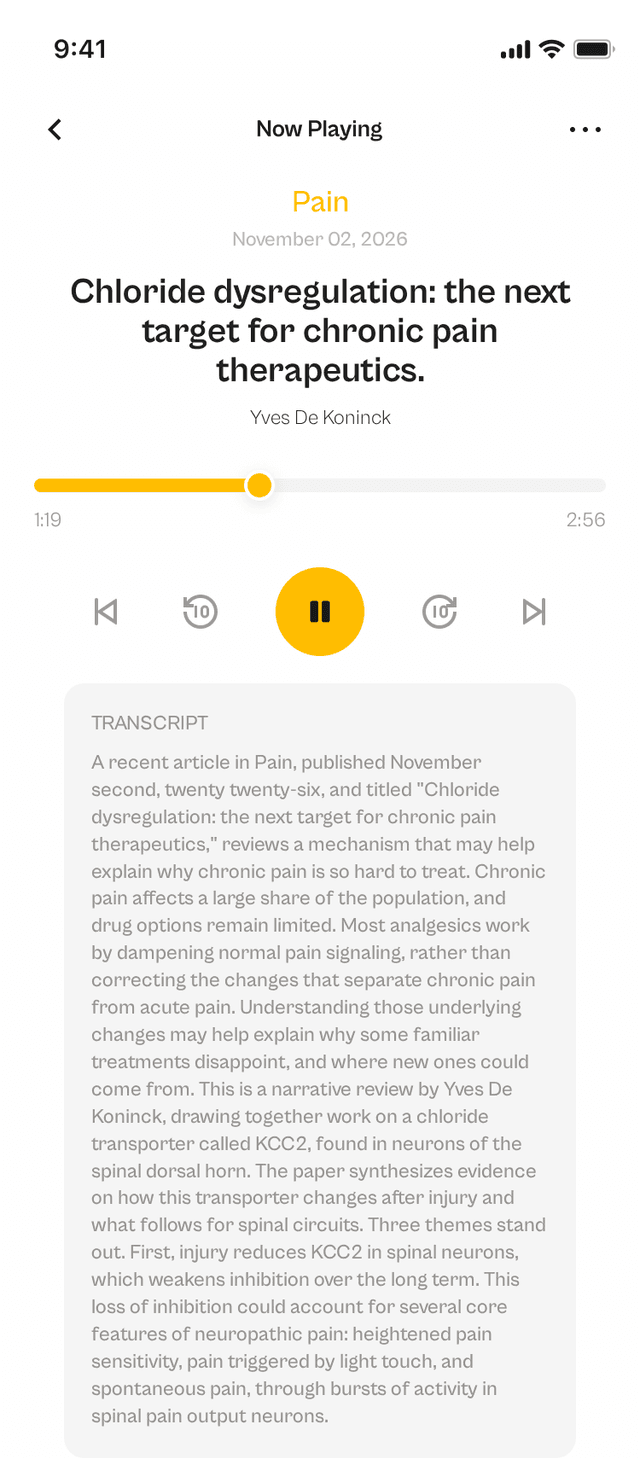
This review argues that chronic pain treatments have failed because they suppress normal pain signaling rather than correcting the pathological mechanisms specific to chronic pain. The author highlights injury-induced loss of the chloride transporter KCC2 in spinal dorsal horn neurons as a mechanism for inhibitory failure that can explain key neuropathic pain symptoms, and shows how chloride dysregulation produces counterintuitive effects, such as benzodiazepines potentially becoming pro-excitatory. The paper positions KCC2 as a promising therapeutic target for both analgesia and disease modification.
This is one of 33,000+ journals available on OSLR. Try it free for 14 days.
Free 14-day trial. 33,000+ journals. Cancel anytime.
More from Pain
View all →Nov 2, 2026 · Pain
Life course trajectories of musculoskeletal pain.
Nov 2, 2026 · Pain
Exercise therapy for chronic pain: an updated perspective on mesocorticolimbic system function.
Nov 2, 2026 · Pain
Prediction and prevention of pain after surgery.
Nov 2, 2026 · Pain
Molecular histochemical analysis of neuroplasticity-related gene expression in pain pathway.
Nov 2, 2026 · Pain
Brain sites involved in endogenous analgesia.
Nov 2, 2026 · Pain
Under pressure: lessons from and beyond entrapment neuropathies.
More in Anesthesiology
View all →Nov 20, 2026 · Anaesthesia
Opioid-free vs. opioid-inclusive anaesthesia in laparoscopic cholecystectomy: a multicentre randomised controlled trial.
Nov 20, 2026 · Anaesthesia
Incidence of pain, supplemental analgesia and conversion to general anaesthesia during intrapartum caesarean delivery using converted epidural anaesthesia: a meta-analysis.
Nov 20, 2026 · British journal of anaesthesia
Beyond the binary: vaping and the changing face of perioperative pulmonary risk.
Nov 20, 2026 · British journal of anaesthesia
Postoperative delirium is associated with accelerated brain ageing: an exploratory cohort study.
Nov 20, 2026 · British journal of anaesthesia
Association of preoperative vaping-related disorder versus cigarette nicotine dependence with postoperative respiratory complications: a multicentre matched cohort study.
Nov 20, 2026 · British journal of anaesthesia
Intraoperative peripheral perfusion index and mortality after noncardiac surgery: a retrospective cohort study.
"Oslr has become part of my weekly routine on my day off. The clinical relevance of the summaries is outstanding — I'd rate it 9/10. Being able to consume research hands-free is a huge advantage for busy physicians."

Dr. Jennifer Thompson
Portland, OR
Stay current without falling behind
33,000+ journals. 3-minute audio summaries. Free for 14 days.