
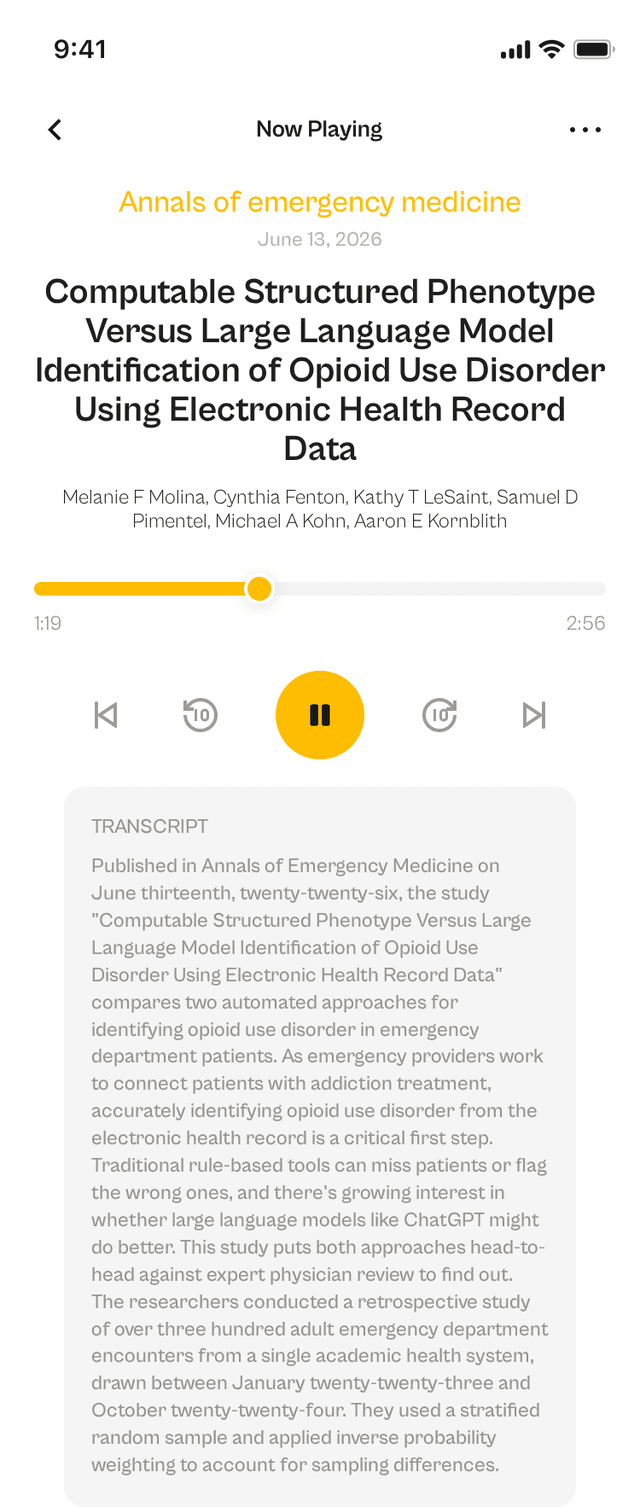
Computable Structured Phenotype Versus Large Language Model Identification of Opioid Use Disorder Using Electronic Health Record Data
Listen to this summary
The authors aimed to compare the effectiveness of a rule-based computable phenotype and a large language model in identifying opioid use disorder among patients in the emergency department, using expert physician review as the reference standard. Their findings indicated that while both methods demonstrated strong diagnostic performance, the large language model had significantly higher specificity and positive predictive value, suggesting it may be more effective in minimizing false-positive alerts in clinical settings. Further validation in diverse populations is recommended to confirm these results.
This is one of 33,000+ journals available on OSLR. Try it free for 14 days.
Free 14-day trial. 33,000+ journals. Cancel anytime.
More from Annals of emergency medicine
View all →Jun 18, 2026 · Annals of emergency medicine
Accuracy of Point-of-Care Ultrasound Versus Consultative Echocardiography to Identify Right Ventricular Dysfunction in Emergency Department Patients With Pulmonary Embolism
Jun 18, 2026 · Annals of emergency medicine
Improving End-of-Life Screening in the Emergency Department With Collaborative Artificial Intelligence
Jun 18, 2026 · Annals of emergency medicine
Palliative Care in Emergency Medicine: A Perspective from a Trainee
Jun 13, 2026 · Annals of emergency medicine
Pharmacy Interventions on Medication Orders Increase With Emergency Medicine Clinician Time-on-Shift
Jun 12, 2026 · Annals of emergency medicine
Medical Scribe and Ambient Artificial Intelligence Impact on Emergency Physician Documentation Burden and Clinical Productivity
Jun 11, 2026 · Annals of emergency medicine
Defining Diagnostic Excellence and Missed Diagnostic Opportunity for the Emergency Department Setting
More in Emergency Medicine
View all →Jun 23, 2026 · The American journal of emergency medicine
Status epilepticus in patients with known epilepsy presenting to the emergency department: Predictors and mortality risk
Jun 23, 2026 · Emergency medicine journal : EMJ
Concordance between an artificial intelligence self-triage programme and physical triage
Jun 22, 2026 · Resuscitation
Diastolic blood pressure and end-tidal carbon dioxide during adult ICU cardiopulmonary resuscitation: association with return of spontaneous circulation
Jun 22, 2026 · Prehospital emergency care
Prehospital Assessment and Treatment of Infants and Toddlers in Respiratory Distress: A Retrospective Analysis
Jun 22, 2026 · The American journal of emergency medicine
Acute urinary retention presenting as inferior pseudo-STEMI: A case report
Jun 22, 2026 · The American journal of emergency medicine
Vascular Eagle syndrome presenting with expanding cervical hematoma and acute ischemic stroke causing impending airway compromise
"Oslr has become part of my weekly routine on my day off. The clinical relevance of the summaries is outstanding — I'd rate it 9/10. Being able to consume research hands-free is a huge advantage for busy physicians."

Dr. Jennifer Thompson
Portland, OR
Stay current without falling behind
33,000+ journals. 3-minute audio summaries. Free for 14 days.