
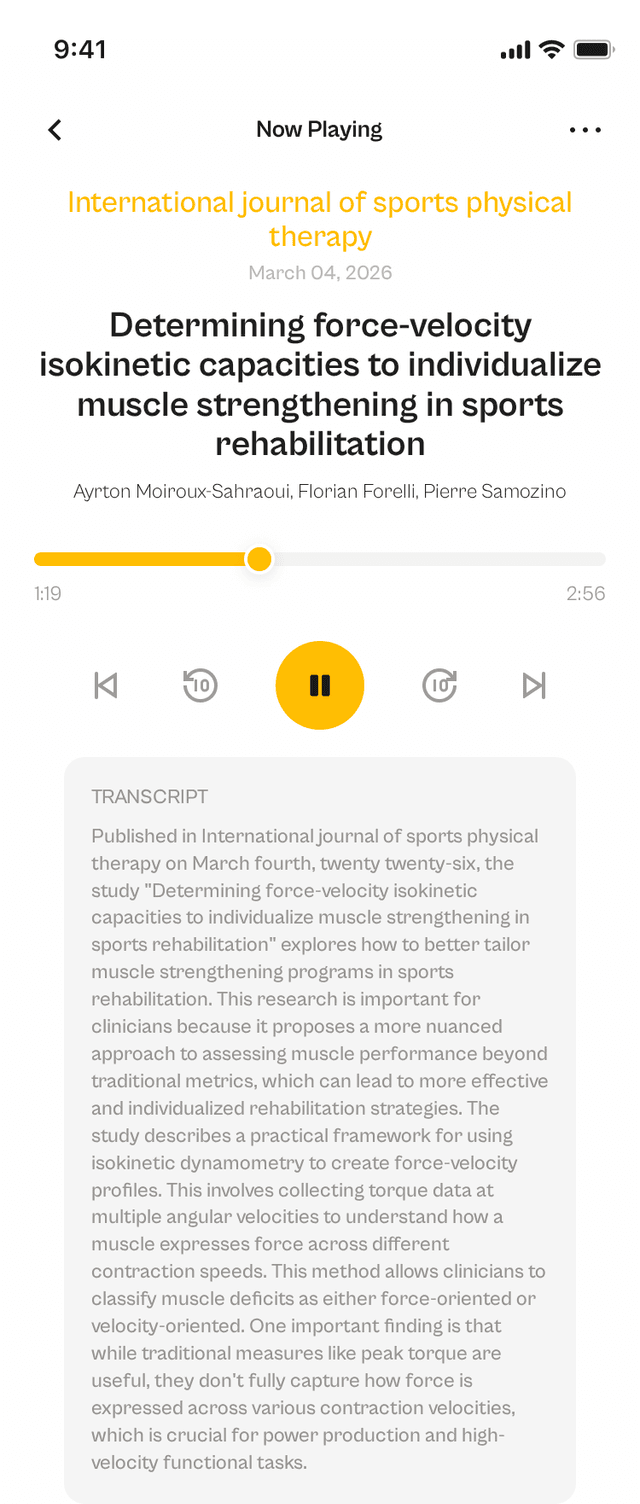
Determining force-velocity isokinetic capacities to individualize muscle strengthening in sports rehabilitation
Listen to this summary
The authors investigate how force-velocity profiling can enhance the individualization of muscle strengthening in sports rehabilitation, moving beyond traditional metrics like peak torque and limb symmetry. They propose that isokinetic dynamometry data, interpreted within a clinical reasoning framework, can help assess muscle performance and guide tailored exercise prescriptions, ultimately improving rehabilitation outcomes. The study emphasizes the importance of linking assessment to exercise prescription to facilitate progression towards sport-specific functional tasks.
This is one of 33,000+ journals available on OSLR. Try it free for 14 days.
Free 14-day trial. 33,000+ journals. Cancel anytime.
More from International journal of sports physical therapy
View all →Mar 4, 2026 · International journal of sports physical therapy
Reliability of a Novel Qualitative Assessment Tool for Evaluating a Run Plant Task
Mar 4, 2026 · International journal of sports physical therapy
Why Your Patient May Need a Bankart Repair Plus Remplissage
Mar 4, 2026 · International journal of sports physical therapy
Insertional Achilles Tendinopathy with Haglund's Deformity: A Progressive Approach to Post-Operative Rehabilitation in Athletes
Mar 4, 2026 · International journal of sports physical therapy
An Exploratory Analysis of Countermovement Jump Variables Between Higher and Lower Performers on the LESS and Y-Balance Tests
Mar 4, 2026 · International journal of sports physical therapy
Diagnostic Musculoskeletal Ultrasound in the Evaluation of the Triangular Fibrocartilage Complex
Mar 4, 2026 · International journal of sports physical therapy
Multiligamentous Knee Reconstruction Complicated by Septic Arthritis Following Cosmetic Surgery, A Case Report
More in Physical Therapist
View all →Mar 25, 2026 · The American journal of sports medicine
Lateral Extra-articular Tenodesis Restores Knee Rotational and Translational Stability Regardless of Fixation Type: A Matched-Pair Cadaveric Study
Mar 25, 2026 · The American journal of sports medicine
Tibiofemoral Load Sharing and Lateral Meniscal Function Are Restored in Tibia- and Capsular-Based Repair of Type 3 Lateral Meniscal Oblique Radial Tears
Mar 25, 2026 · The American journal of sports medicine
Clinical Outcomes of Unipolar Versus Bipolar Patellofemoral Fresh Osteochondral Allograft Transplantation
Mar 25, 2026 · British journal of sports medicine
Injury risk and its relationship with biological maturation among 100 junior tennis athletes: a 15-year retrospective analysis
Mar 25, 2026 · The American journal of sports medicine
Deltoid Osteomuscular Transfer Suppresses Humeral Head Translation Caused by Massive Irreparable Rotator Cuff Tears: A Cadaveric Biomechanical Study
Mar 24, 2026 · British journal of sports medicine
Impact of physical activity patterns on major adverse cardiovascular events in adults with hypertension
"Oslr has become part of my weekly routine on my day off. The clinical relevance of the summaries is outstanding — I'd rate it 9/10. Being able to consume research hands-free is a huge advantage for busy physicians."

Dr. Jennifer Thompson
Portland, OR
Stay current without falling behind
33,000+ journals. 3-minute audio summaries. Free for 14 days.