
Artificial Intelligence and Cardiovascular Disease Prevention: Newton's Second Law Readdressed with a Cautionary Note.
Listen to this summary
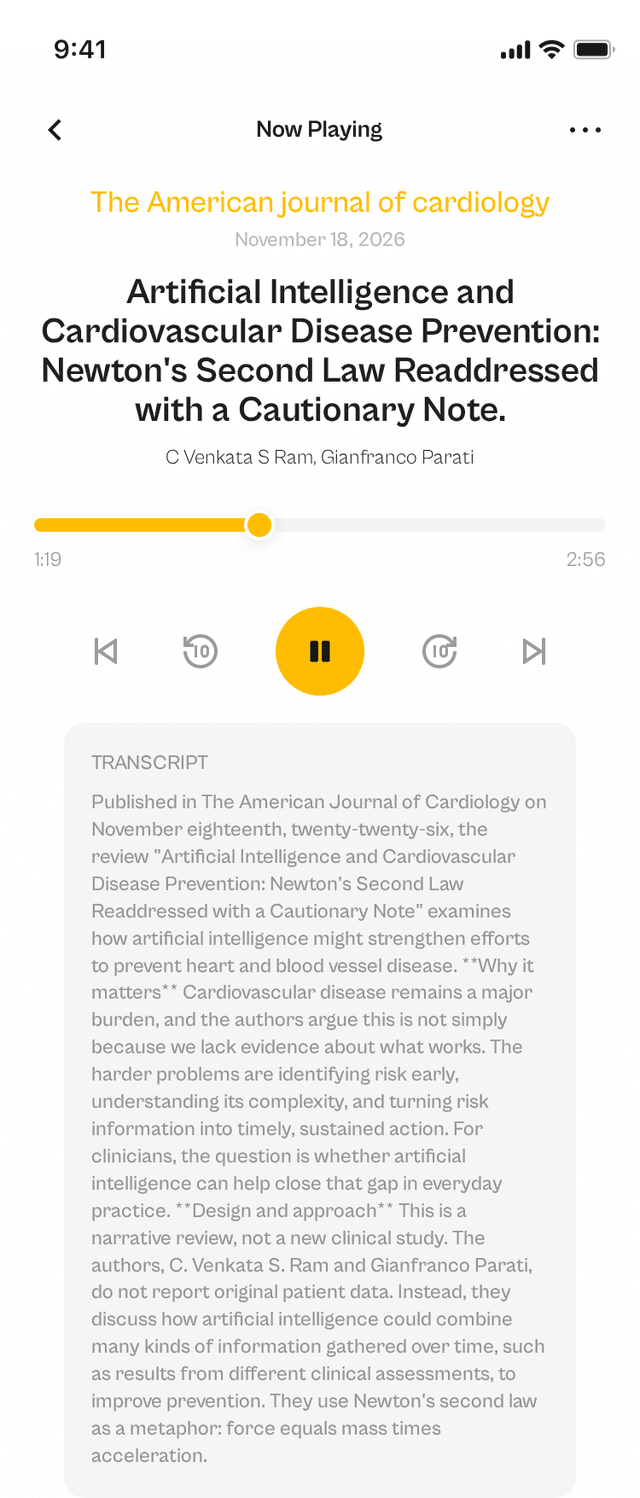
This review uses Newton's second law (Force = Mass × Acceleration) as a metaphor to ask how artificial intelligence can strengthen cardiovascular prevention beyond static, conventional risk estimation. The authors argue that AI can integrate multimodal and longitudinal data to improve risk prediction, uncover latent phenotypes, detect subclinical disease earlier, and enable continuous, personalized intervention. They conclude that AI's value will ultimately depend on moving from prediction to demonstrable reductions in cardiovascular events and mortality, delivered sustainably and equitably.
This is one of 33,000+ journals available on OSLR. Try it free for 14 days.
Free 14-day trial. 33,000+ journals. Cancel anytime.
More from The American journal of cardiology
View all →Nov 19, 2026 · The American journal of cardiology
Longitudinal NT-proBNP Target Attainment and Clinical Outcomes in Heart Failure With Reduced Ejection Fraction: A Landmark Analysis of the GUIDE-IT Trial.
Nov 19, 2026 · The American journal of cardiology
Timing of Coronary Angiography After Successful Fibrinolysis and Clinical Outcomes in ST-Segment Elevation Myocardial Infarction Patients.
Nov 19, 2026 · The American journal of cardiology
Cardiovascular Outcomes of Semaglutide in Adults With Congenital Heart Disease.
Nov 19, 2026 · The American journal of cardiology
Eximer Laser Coronary Atherectomy in the Current era of Complex Percutenoues Coronary Intervention: New Insights from the ACCELERATE (eAst siCily exCimEr LasER ATherEctomy) Registry.
Nov 18, 2026 · The American journal of cardiology
Effect of High-Intensity Statin Therapy on Coronary Plaque Composition Assessed by Machine Learning-Based Optical Coherence Tomography Analysis.
Nov 18, 2026 · The American journal of cardiology
Immune checkpoint inhibitors-induced -induced vs. Conventional Myocarditis: Navigating Pathophysiological and Clinical Divergences.
"Oslr has become part of my weekly routine on my day off. The clinical relevance of the summaries is outstanding — I'd rate it 9/10. Being able to consume research hands-free is a huge advantage for busy physicians."

Dr. Jennifer Thompson
Portland, OR
Stay current without falling behind
33,000+ journals. 3-minute audio summaries. Free for 14 days.