
Religion and Religiosity in End-of-Life Decisions in Neurocritical Care.
Listen to this summary
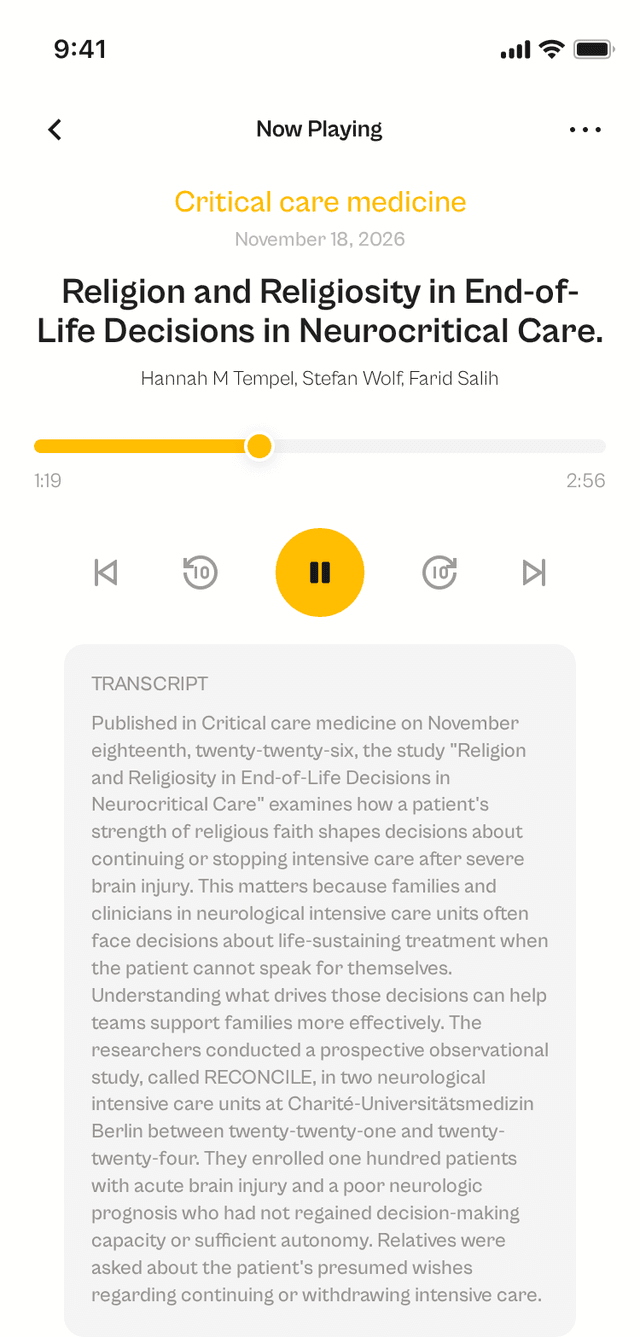
The RECONCILE study asked whether the strength of a patient's religious faith (religiosity), rather than religious affiliation itself, shapes end-of-life decisions in neurocritical care. In 100 patients with acute brain injury and poor prognosis, relatives' reports of presumed wishes were paired with religiosity scores from the Santa Clara Strength of Religious Faith questionnaire. Patients whose intensive care was continued had significantly higher religiosity scores than those whose care was withdrawn, with religion, age, and sex showing no significant association, suggesting that higher religiosity is linked to preferences for more aggressive treatment even when prognosis is poor.
This is one of 33,000+ journals available on OSLR. Try it free for 14 days.
Free 14-day trial. 33,000+ journals. Cancel anytime.
More from Critical care medicine
View all →Nov 19, 2026 · Critical care medicine
Prevalence and Characteristics of Coma in Latin American Critical Care Units: The COMA LATAM Study.
Nov 18, 2026 · Critical care medicine
Age-Related Differences in the Organ Donation Process Among Pediatric Brain-Dead Donors: A Nationwide Study in Japan.
Nov 18, 2026 · Critical care medicine
High-Flow Nasal Cannula Versus Conventional Oxygen Therapy in Adults With De Novo Acute Hypoxemic Respiratory Failure: A Systematic Review and Meta-Analysis With Trial Sequential Analysis.
Nov 18, 2026 · Critical care medicine
ICU Mortality Associated With Clinically Important Upper Gastrointestinal Bleeding: A Multistate Analysis.
Nov 18, 2026 · Critical care medicine
The Radiographic Lung Edema Score in Pediatric Acute Respiratory Failure: Associations With Systemic Inflammatory Biomarkers and Multiple Organ Dysfunction.
Nov 13, 2026 · Critical care medicine
A Guytonian Atlas of Venous Return in Septic Shock: Reconstruction of Hemodynamic States.
More in Pediatrics
View all →Nov 20, 2026 · Journal of clinical oncology : official journal of the American Society of Clinical Oncology
Effect of a Multidisciplinary Intervention on Fatigue in Lymphoma Survivors With Persistent Fatigue: A Randomized Controlled Trial (the REFUEL trial).
Nov 20, 2026 · Journal of clinical oncology : official journal of the American Society of Clinical Oncology
Reach of State-Mandated Insurance Coverage for Fertility Preservation in Patients With Cancer.
Nov 20, 2026 · Journal of clinical oncology : official journal of the American Society of Clinical Oncology
Alectinib as Neoadjuvant Treatment in Potentially Resectable Stage III Anaplastic Lymphoma Kinase-Positive Non-Small Cell Lung Cancer: ALNEO Phase II Trial (GOIRC-01-2020-ML42316).
Nov 20, 2026 · Hormone research in paediatrics
Post-Menarcheal Height Gain After Gonadotropin-Releasing Hormone Agonist Treatment in Girls with Central Precocious Puberty.
Nov 20, 2026 · Hormone research in paediatrics
JUVENILE IDIOPATHIC ARTHRITIS IN CHILDREN WITH TYPE 1 DIABETES: IMPACT OF CURRENT MEDICAL TREATMENT OPTIONS ON ANTHROPOMETRY AND METABOLIC CONTROL.
Nov 20, 2026 · European heart journal
Acute pulmonary embolism: long-term cause-specific mortality in a Chinese nationwide registry.
"Oslr has become part of my weekly routine on my day off. The clinical relevance of the summaries is outstanding — I'd rate it 9/10. Being able to consume research hands-free is a huge advantage for busy physicians."

Dr. Jennifer Thompson
Portland, OR
Stay current without falling behind
33,000+ journals. 3-minute audio summaries. Free for 14 days.