
CENTRAL NERVOUS SYSTEM GRAFT VERSUS HOST DISEASE PATHOPHYSIOLOGY: MECHANISTIC PATHWAYS AND THERAPEUTIC TARGETS.
Listen to this summary
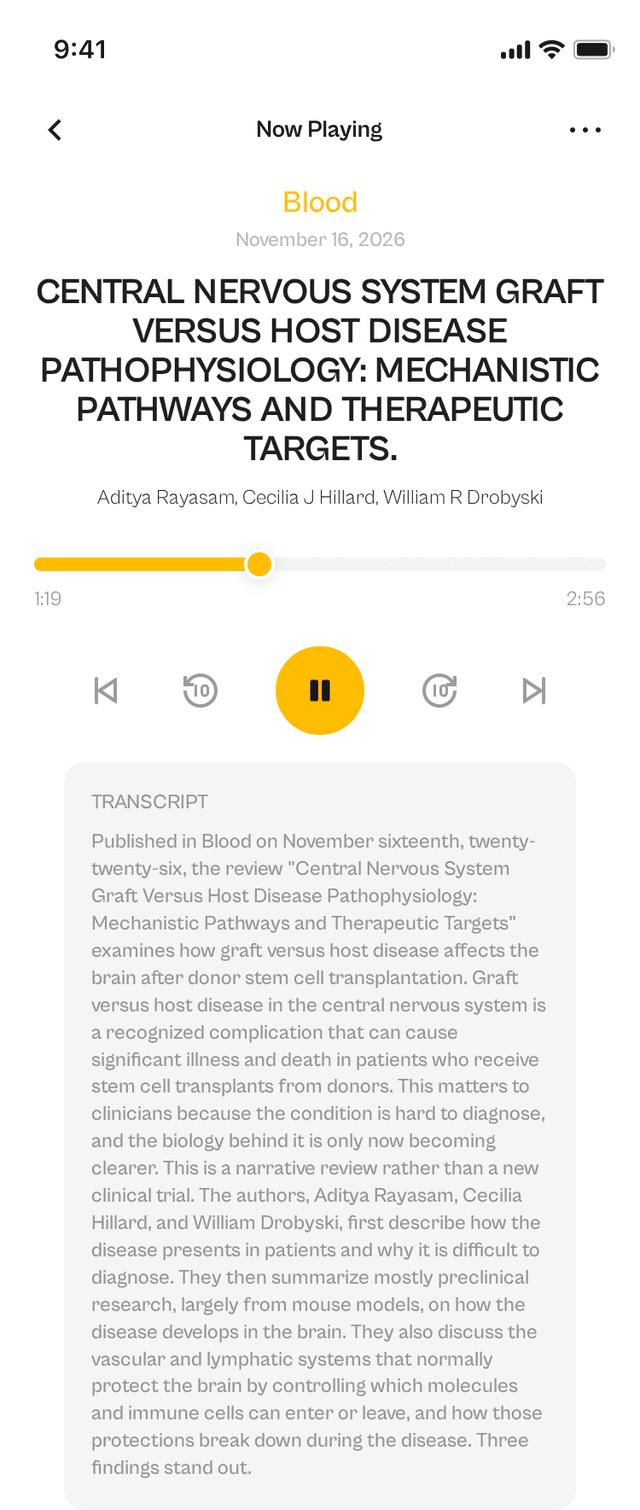
This review examines how graft-versus-host disease (GVHD) affects the central nervous system (CNS) after allogeneic stem cell transplantation, a complication associated with significant morbidity and mortality. The authors synthesize mostly murine studies to explain how disrupted vascular and lymphatic barriers allow immune cell entry into the brain, and which pathways (IL-6, TNF-α, CB2 receptor, CSF-1R, and antibiotic-induced gut dysbiosis) drive neuroinflammation. They also show that therapies effective against peripheral GVHD do not always work in the brain, underscoring the brain's distinct microenvironment and suggesting strategies to restore barrier integrity and limit T cell trafficking into the CNS.
This is one of 33,000+ journals available on OSLR. Try it free for 14 days.
Free 14-day trial. 33,000+ journals. Cancel anytime.
More from Blood
View all →Nov 18, 2026 · Blood
Endothelial IDO1 Drives BBB Disruption in CAR-T-Associated Neurotoxicity Through KYNU-AA-Wnt/β-catenin Pathway.
Nov 17, 2026 · Blood
Cytokines to modulate CAR T cells.
Nov 16, 2026 · Blood
Microbiota-derived short-chain fatty acids control cGVHD development by regulating antibody production.
Nov 16, 2026 · Blood
Regenerative Stress Contributes to Higher Clonal Hematopoiesis with Myelodysplastic Features in Sickle Cell Disease Mice.
Nov 16, 2026 · Blood
Carfilzomib-based strategies in transplant-eligible multiple myeloma: long-term follow-up of the phase 2 FORTE trial.
Nov 16, 2026 · Blood
Etentamig in Relapsed/Refractory Multiple Myeloma: Pooled Phase 1 Data of an Investigational BCMA Bispecific Antibody.
More in Internal Medicine
View all →Nov 20, 2026 · Reproductive biology and endocrinology : RB&E
Sirtuin 1-dependent oleanolic acid protection attenuates oxidative stress-induced granulosa cell dysfunction and ovarian damage.
Nov 20, 2026 · Journal of pain and symptom management
ACCOMPANI: A Psychosocial Nurse Intervention for African American Families in Pediatric Oncology.
Nov 20, 2026 · Mayo Clinic proceedings
Patient-Staff Interaction in ED by Real-time Location System: Novel Predictors of In-hospital Mortality Enhancing APACHE III/APS in ICU Patients.
Nov 20, 2026 · Journal of pain and symptom management
Perceived Clinical Utility of a Routine Family Experience Feedback Loop in Pediatric Palliative Care.
Nov 20, 2026 · Journal of pain and symptom management
Predictors of Clinician Success, Quality, and Resilience in Outpatient Pediatric Palliative Care.
Nov 20, 2026 · Kidney international
The effects of size and sex mismatch on kidney functional adaption following living donor kidney transplantation.
"Oslr has become part of my weekly routine on my day off. The clinical relevance of the summaries is outstanding — I'd rate it 9/10. Being able to consume research hands-free is a huge advantage for busy physicians."

Dr. Jennifer Thompson
Portland, OR
Stay current without falling behind
33,000+ journals. 3-minute audio summaries. Free for 14 days.