
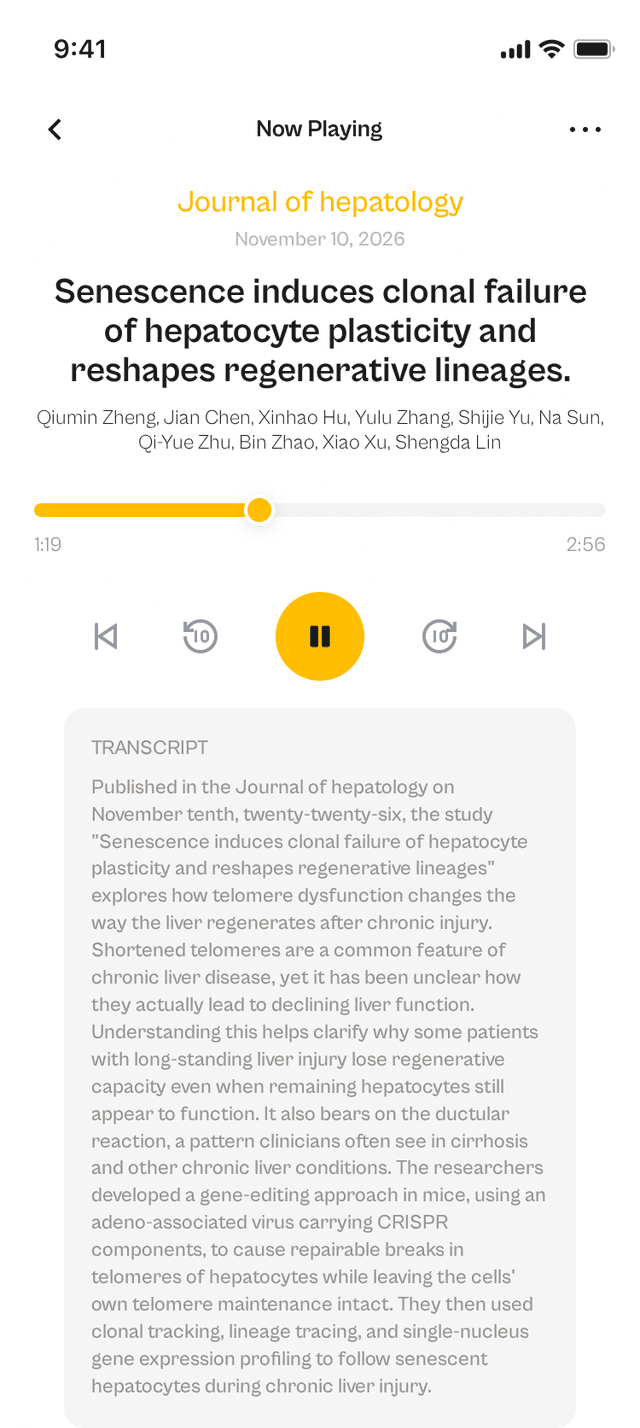
Senescence induces clonal failure of hepatocyte plasticity and reshapes regenerative lineages.
Listen to this summary
Telomere dysfunction is a known driver of cellular senescence and chronic liver disease, but how physiological, resolvable telomere damage affects liver regeneration has been unclear. Using an AAV-CRISPR system to induce telomeric breaks in mouse hepatocytes, the authors found that senescence did not substantially impair hepatocyte survival or basal metabolism, but instead blocked hepatocyte-to-ductal metaplasia during chronic injury, skewing clonal composition and worsening the ductular reaction. Human cirrhotic data linked preserved telomere integrity to bipotent hepatocyte states, and an in vivo CRISPR screen identified regulators of hepatocyte dedifferentiation under telomere stress, positioning senescence as a constraint on hepatocyte plasticity rather than a direct cause of hepatocyte loss.
This is one of 33,000+ journals available on OSLR. Try it free for 14 days.
Free 14-day trial. 33,000+ journals. Cancel anytime.
More from Journal of hepatology
View all →Nov 19, 2026 · Journal of hepatology
Checkpoint Inhibition during primary hepatitis E virus infection alters memory development of virus-specific T-cells in humans.
Nov 13, 2026 · Journal of hepatology
Translocation of the environmental bacterium Aquitalea magnusonii promotes systemic inflammation and liver fibrosis in chronic liver disease.
Nov 8, 2026 · Journal of hepatology
Seladelpar for alkaline phosphatase normalization in primary biliary cholangitis: The IDEAL phase III randomized controlled trial.
Nov 2, 2026 · Journal of hepatology
Liver biopsy confirms precise and efficient correction of SERPINA1 after in vivo Base Editing in a Patient with Alpha-1 Antitrypsin Deficiency.
Oct 28, 2026 · Journal of hepatology
Crosstalk along the gut-liver axis in liver disease: Clinical and mechanistic aspects.
Oct 26, 2026 · Journal of hepatology
Intestinal Candida albicans promotes HCC progression and anti-PD-1 resistance via IL-17A and Trem2+ macrophages.
More in Internal Medicine
View all →Nov 20, 2026 · Reproductive biology and endocrinology : RB&E
Sirtuin 1-dependent oleanolic acid protection attenuates oxidative stress-induced granulosa cell dysfunction and ovarian damage.
Nov 20, 2026 · Journal of pain and symptom management
ACCOMPANI: A Psychosocial Nurse Intervention for African American Families in Pediatric Oncology.
Nov 20, 2026 · Mayo Clinic proceedings
Patient-Staff Interaction in ED by Real-time Location System: Novel Predictors of In-hospital Mortality Enhancing APACHE III/APS in ICU Patients.
Nov 20, 2026 · Journal of pain and symptom management
Perceived Clinical Utility of a Routine Family Experience Feedback Loop in Pediatric Palliative Care.
Nov 20, 2026 · Journal of pain and symptom management
Predictors of Clinician Success, Quality, and Resilience in Outpatient Pediatric Palliative Care.
Nov 20, 2026 · Kidney international
The effects of size and sex mismatch on kidney functional adaption following living donor kidney transplantation.
"Oslr has become part of my weekly routine on my day off. The clinical relevance of the summaries is outstanding — I'd rate it 9/10. Being able to consume research hands-free is a huge advantage for busy physicians."

Dr. Jennifer Thompson
Portland, OR
Stay current without falling behind
33,000+ journals. 3-minute audio summaries. Free for 14 days.