
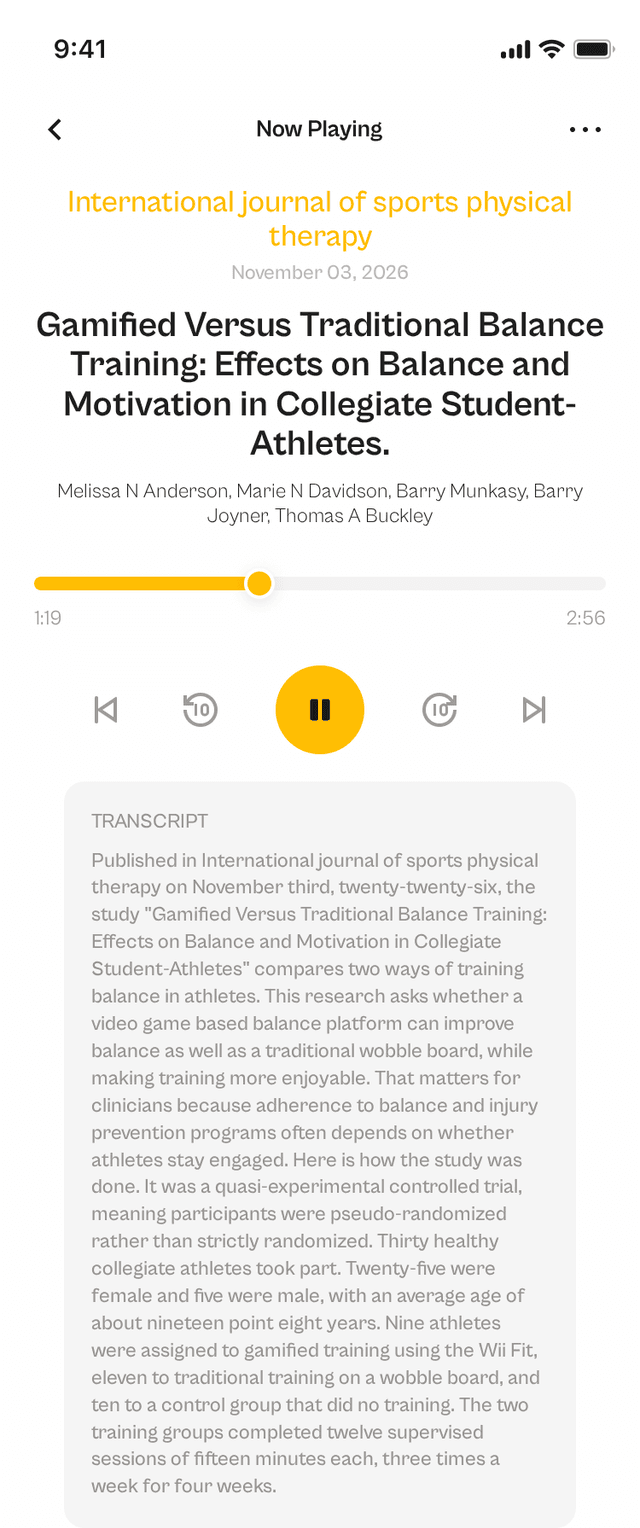
Gamified Versus Traditional Balance Training: Effects on Balance and Motivation in Collegiate Student-Athletes.
Listen to this summary
This study compared gamified balance training (Wii Fit) with traditional wobble board training in 30 collegiate athletes to determine whether the gamified approach could improve dynamic balance and motivation. Both training groups improved mSEBT scores over four weeks relative to controls, with no significant change in DPSI, and the gamified group reported significantly higher interest and enjoyment. The authors conclude that gamified training produces dynamic balance gains similar to traditional training while being more enjoyable, making it a potentially engaging option for rehabilitation and injury-prevention programs.
This is one of 33,000+ journals available on OSLR. Try it free for 14 days.
Free 14-day trial. 33,000+ journals. Cancel anytime.
More from International journal of sports physical therapy
View all →Nov 6, 2026 · International journal of sports physical therapy
Beyond Reconstruction: Return to Olympic Medal Performance Following Morphology-Informed and Criterion-Based Nonoperative Management of a Femoral-Sided Sherman Type II ACL Injury - A Case Report.
Nov 6, 2026 · International journal of sports physical therapy
Diagnostic Musculoskeletal Ultrasound in the Evaluation of the Extensor Digitorum Longus.
Nov 3, 2026 · International journal of sports physical therapy
Ultrasound-Guided Percutaneous Tendon Dry Needling for Recalcitrant Distal Biceps Tendinopathy: A Case Series.
Nov 3, 2026 · International journal of sports physical therapy
Effects of Blood Flow Restriction Training on Pain Perception in Athletes with Sacroiliac Joint Dysfunction: A Case Series.
Nov 3, 2026 · International journal of sports physical therapy
Surface EMG Characterization of the Jefferson Curl at a Submaximal Load Matched to the Romanian Deadlift: A Cross-Sectional Study in Resistance-Trained Adults.
Nov 3, 2026 · International journal of sports physical therapy
Diagnosis, Rehabilitation, and Return to Sport after Athletic Hamstring Injury: An ICCUS Society Consensus Statement.
More in Physical Therapist
View all →Nov 18, 2026 · Orthopaedic journal of sports medicine
Sex Does Not Influence Graft Failure or Functional Recovery After Anterior Cruciate Ligament Reconstruction: A Systematic Review and Meta-Analysis.
Nov 18, 2026 · Orthopaedic journal of sports medicine
Incidence of Flatfoot Deformity After Anterior Cruciate Ligament Reconstruction Using Peroneus Longus Autograft: A Mid-Term Observational Study.
Nov 18, 2026 · Orthopaedic journal of sports medicine
Anterior Capsulolabral Repair During Arthroscopic Latarjet Reduces the Risk of Osteoarthritis Development: A Matched-Pair Study.
Nov 18, 2026 · Orthopaedic journal of sports medicine
Some Skeletally Immature Patients Have Lower Limb Length Discrepancies and/or Malalignment Prior to Anterior Cruciate Ligament Reconstruction: Baseline Radiographic Data from the PLUTO Cohort.
Nov 18, 2026 · Orthopaedic journal of sports medicine
Translation, Validity, and Reliability of the Indonesian Version of the Injury-Psychological Readiness to Return to Sport (I-PRRS-INA) Scale.
Nov 18, 2026 · Orthopaedic journal of sports medicine
Tendon Graft Augmentation Was Not Associated With Improved Outcomes in Acute Bidirectionally Unstable High-Grade AC Joint Injuries: A Retrospective Cohort Study.
"Oslr has become part of my weekly routine on my day off. The clinical relevance of the summaries is outstanding — I'd rate it 9/10. Being able to consume research hands-free is a huge advantage for busy physicians."

Dr. Jennifer Thompson
Portland, OR
Stay current without falling behind
33,000+ journals. 3-minute audio summaries. Free for 14 days.